33/220 kV Pooling Substation
- Client
- Anandshree Renewables
- Scope
- Complete detailed engineering consultancy

Infrastructure sector
Collector feeder bays, pooling transformers, AIS/GIS switchyards and evacuation bays for solar, wind, hybrid and storage projects, at 33/132 kV, 33/220 kV, 220/33 kV and other project voltages.
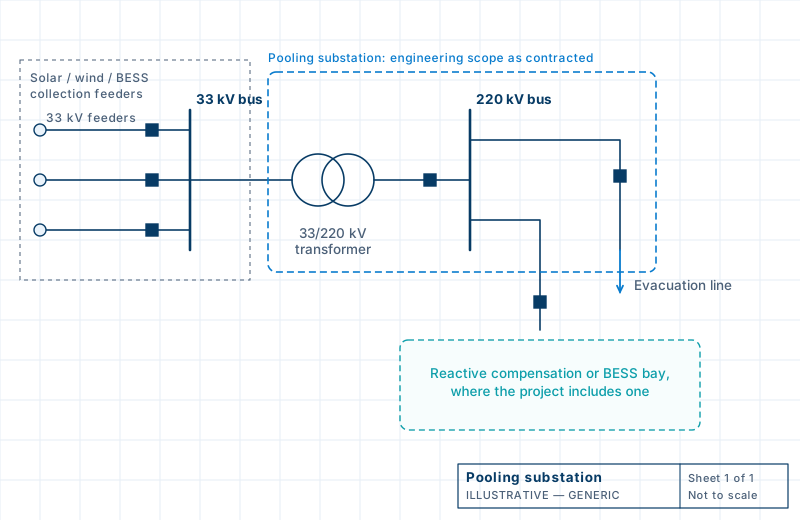
A pooling substation collects the output of a renewable plant, or several plants, from medium-voltage collector feeders and steps it up through one or more power transformers to the transmission voltage. Its outgoing bays connect to the evacuation line that carries power to the grid.
The design has to satisfy two sets of requirements at once: the plant side, where feeder count, ratings and protection follow the plant layout, and the utility side, where metering, protection, SCADA and switching arrangements follow the connection approval. Names such as 33/220 kV and 220/33 kV describe the same kind of station from opposite directions; we follow the project’s own convention.
Typical voltage pairs. 33/132 kV, 33/220 kV and 220/33 kV, with 400 kV evacuation on larger schemes. The project decides the arrangement.
Delivered as detailed engineering. The contract defines which disciplines and items are included.
| Input | Why it matters |
|---|---|
| Plant capacity and collector feeder count | Sets bay count, bus rating and transformer size |
| Connection approval and utility requirements | Fix evacuation voltage, metering, protection and SCADA arrangements |
| Transformer and switchgear GTPs | Fix dimensions, loads and clearances |
| Soil and survey data | Earthing design, grading and foundations |
| Plant layout and cable routes | Feeder entry positions and trench layout |
| Interface | Typical counterparty | What is coordinated |
|---|---|---|
| Plant collection system | EPC contractor, inverter or turbine OEM | Feeder ratings, cable entries, protection grading |
| Utility connection | Transmission licensee | Metering, protection, SCADA signals, switching |
| BESS or reactive compensation bay | Storage OEM, EPC contractor | Bay rating, protection and control interface |
| Evacuation line | Line designer or EPC contractor | Line entry gantry, tension, shield wire termination |
Client is the company that awarded CoreGrid the work. Plant owners, developers and locations are not shown.
Send us the tender extract, single-line diagram, master deliverable list or the specific calculation you need. We will confirm scope, inputs and a realistic submission sequence before any work starts.