Substations & Switchyards
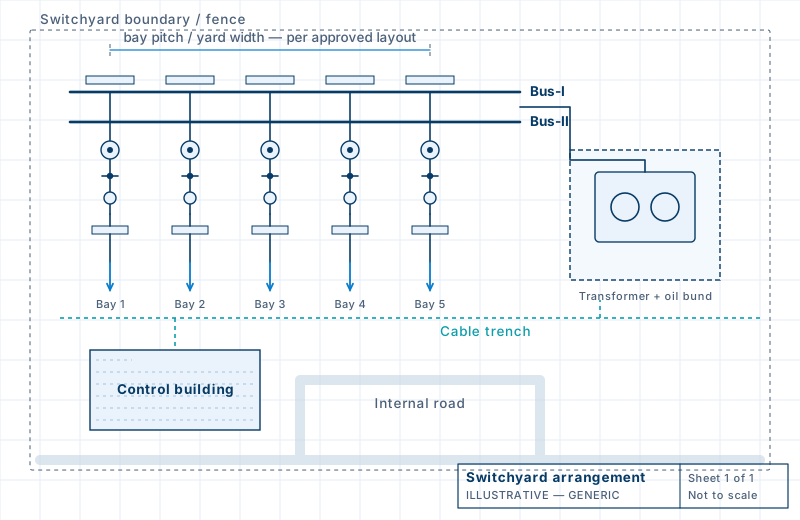
Electrical, civil and structural design for AIS and GIS substations and switchyards: new stations, bay extensions and interconnecting transformer yards.
Substations & Switchyards
Power infrastructure design & engineering consultancy
AIS/GIS substations up to 765 kV, solar and wind pooling stations, BESS integration, AC transmission lines, and multidisciplinary electrical, civil and structural engineering.
We are a consulting engineering firm. We prepare designs, calculations and technical documents for EPC contractors and other project stakeholders, from tender stage to final submission. We do not construct, supply or manufacture.
Swipe sideways to see the whole diagram.
Who we are
CoreGrid Engineering is a consulting engineering firm working on substations, renewable power plants and their pooling stations, battery energy storage, transmission lines and HVDC projects. Electrical and civil/structural design are our core disciplines; the infrastructure types are where we apply them.
Our primary service is post-award detailed engineering for EPC contractors: design criteria, calculations, drawings, schedules and the comment resolution that takes a package to final issue. Tender-stage engineering is the next engagement we offer. What clients get is calculations that trace back to their inputs, drawings that agree with one another, and controlled revisions.
Sectors
Six infrastructure types, each with its own page covering scope, inputs, calculations, drawings and interfaces.
Electrical, civil and structural design for AIS and GIS substations and switchyards: new stations, bay extensions and interconnecting transformer yards.
Substations & Switchyards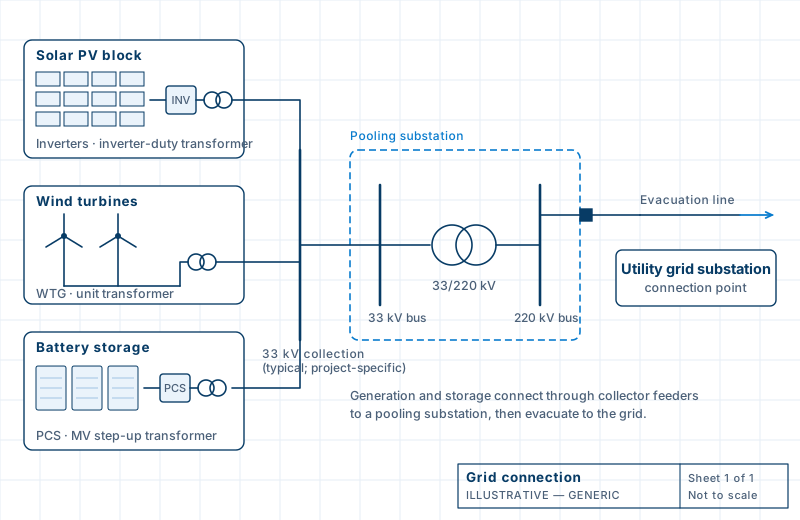
Plant electrical balance of system, collection networks, plant layout interfaces and grid connection for solar, wind and hybrid projects.
Solar, Wind & Hybrid Plants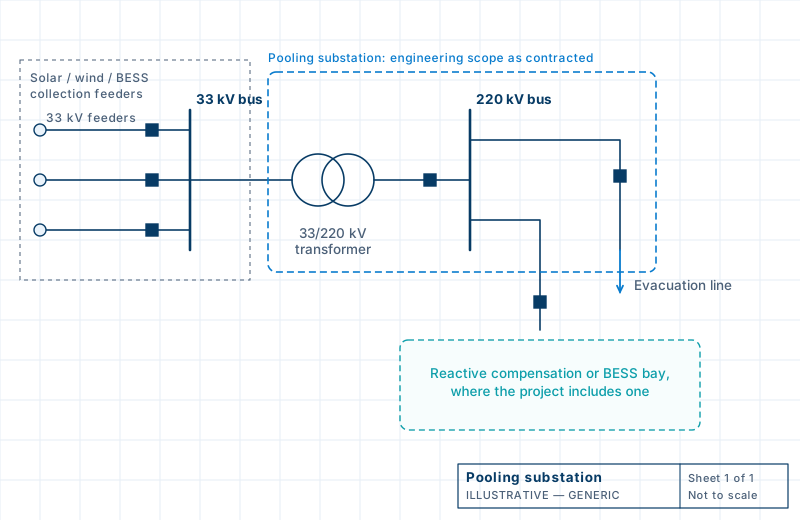
Pooling and evacuation substations that collect renewable output at 33 kV and step it up to 132 kV, 220 kV or higher for the grid.
Pooling Substations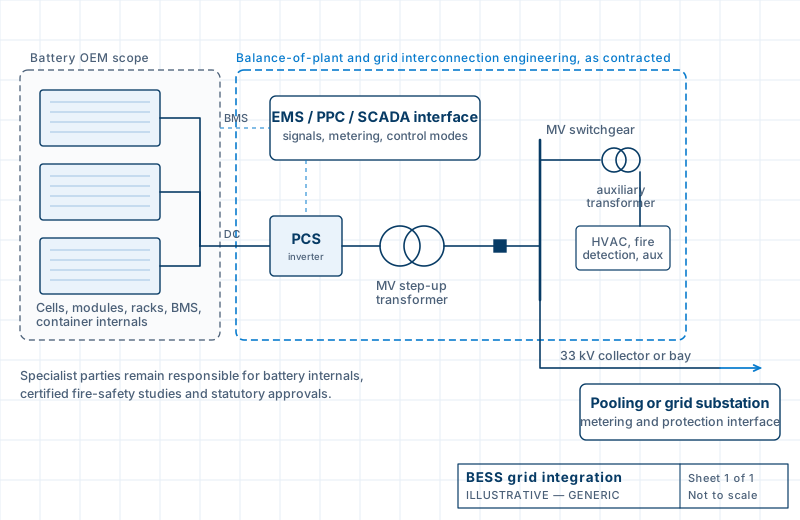
BESS sizing, PCS and transformer interfaces, auxiliary systems, protection and SCADA interfaces, and connection to pooling or grid substations.
Battery Energy Storage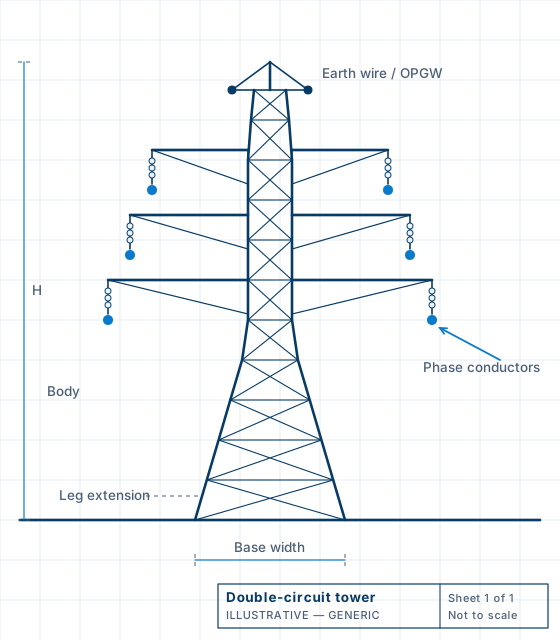
Line electrical design, single and double circuit tower design, sag-tension and stringing, and tower foundations by soil class.
Transmission Lines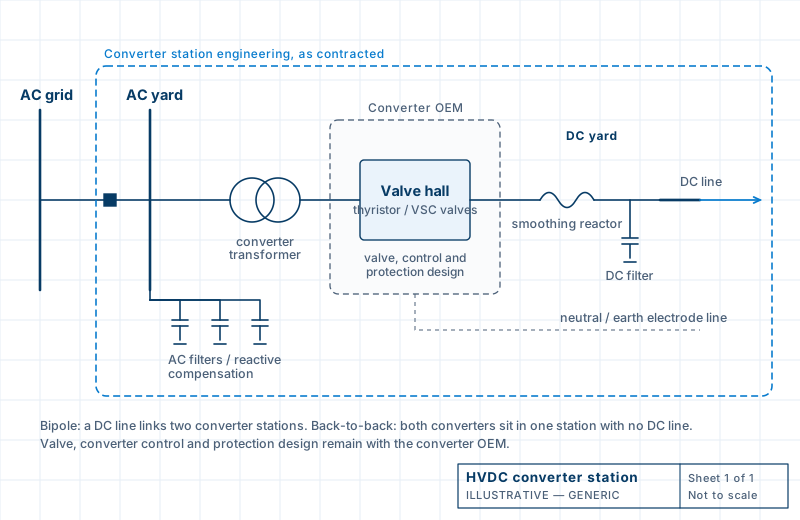
Converter-station engineering, equipment specification and review, and study support for bipole and back-to-back schemes, as contracted.
HVDC EngineeringPrimary service
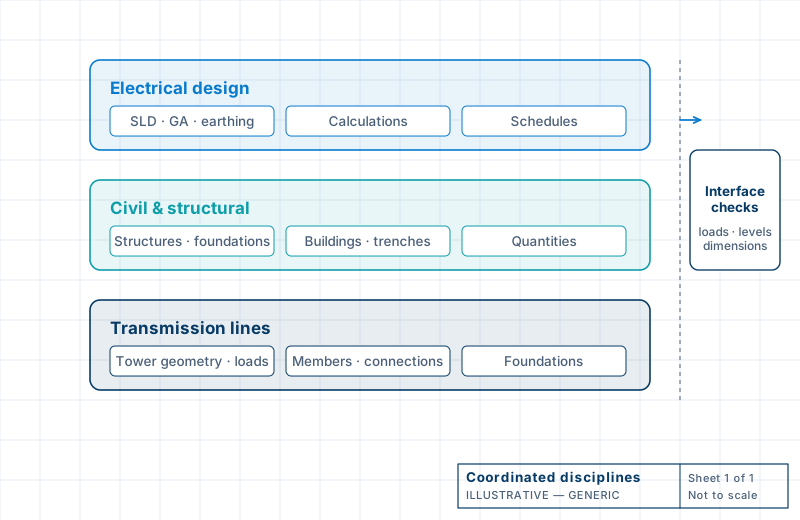
Two core disciplines, applied across substations, renewable plants, storage, lines and HVDC.
Single-line diagrams and key diagrams, AIS/GIS layouts and sections, conductor and busbar sizing, short-circuit forces and sag-tension, earthing and lightning protection, equipment ratings, auxiliary AC/DC systems, cables and illumination, with protection, control and SCADA interfaces where in scope.
Site grading and plot plans, gantries and equipment support structures, transformer and reactor foundations with oil containment, control and GIS buildings, cable trenches, drainage, roads and fencing, with reinforcement drawings, bar bending schedules and quantities.
Detailed engineering is our primary service. After award, a package moves from design criteria to calculations, drawings, schedules and comment resolution. How detailed engineering is organised · Representative deliverables
Renewables, storage & grid connection
A renewable plant reaches the grid in stages. Solar inverters, wind turbines and battery PCS units feed collector circuits, typically at 33 kV. A pooling substation collects those feeders and steps the voltage up, and an evacuation line carries the power to the utility’s substation.
We engineer each stage as contracted: plant electrical balance of system and collection networks, the pooling substation’s electrical and civil design, BESS sizing and grid integration, and the evacuation interface.
How a package moves
Seven stages, applied as each project requires. Select a stage to see typical inputs and outputs.
The package begins with the documents the project provides: technical specification, single-line diagram, bay list, equipment data, site and soil information, and the master deliverable list (MDL). We log what has arrived, what is missing and the order in which the EPC team needs each deliverable.
Design criteria are fixed before calculation starts: voltages, fault levels, ratings, clearances, loading and environmental data. Client and utility criteria take priority, and every assumption goes into an assumptions register for the client to confirm.
Calculations state their inputs, method, formula basis and acceptance limits, so a reviewer can trace each result back to the design basis. Each calculation is checked internally before it is issued.
Discipline drawings are developed from the calculated results and the approved layout, using one coordinate and level reference so that sheets agree with each other.
Electrical, civil, structural and transmission interfaces are checked for loads, levels and dimensions, and designs are updated to approved vendor data. Open information is recorded rather than assumed away.
Documents are submitted in the client’s revision convention. Each comment is logged in a comment resolution sheet, answered, and closed in a revised submission.
When comments are closed, documents are issued in the status the project defines, for example for approval, approved or for construction. Approval is the client’s decision, and we do not describe a document as approved before the approving party has said so.
About status wording. “Issued for approval”, “approved” and “issued for construction” are defined by each project. The client, owner’s engineer or consultant approves; CoreGrid prepares, submits, answers comments and revises.
Next engagement
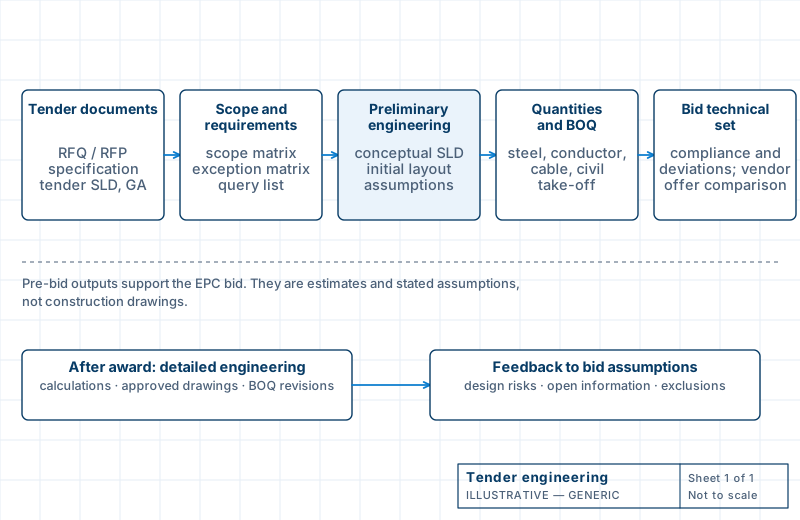
EPC bids are priced before the design is complete. Pre-bid engineering reduces the uncertainty in that price: we read the tender closely, set out what is and is not in scope, and prepare the preliminary engineering from which quantities are taken.
Projects
Voltage, asset type and CoreGrid’s own scope on each assignment.
Client is the company that awarded CoreGrid the engineering work. Asset owners, developers, locations and site identifiers are not shown.
Deliverables
Drawings, calculations, schedules and technical documents, each with a stated purpose, typical inputs and typical outputs.
The library holds more than 130 representative items, searchable by discipline, infrastructure type and document type. It is a reference list: a contract includes the items its specification and MDL call for.
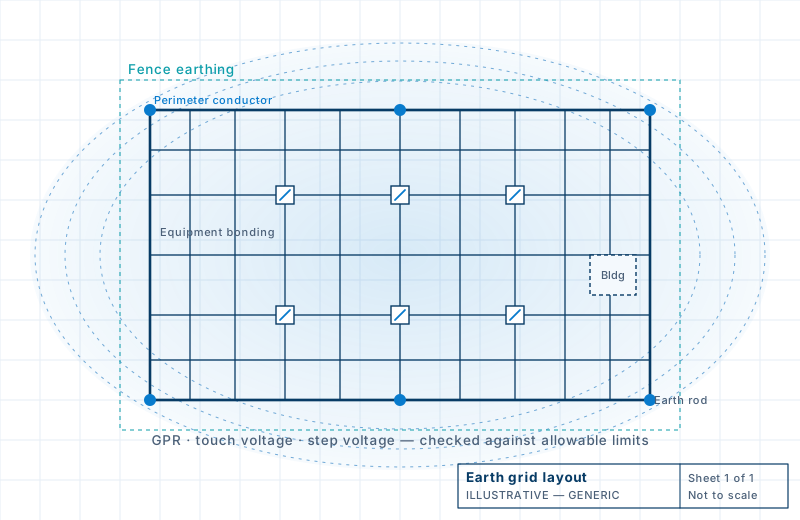
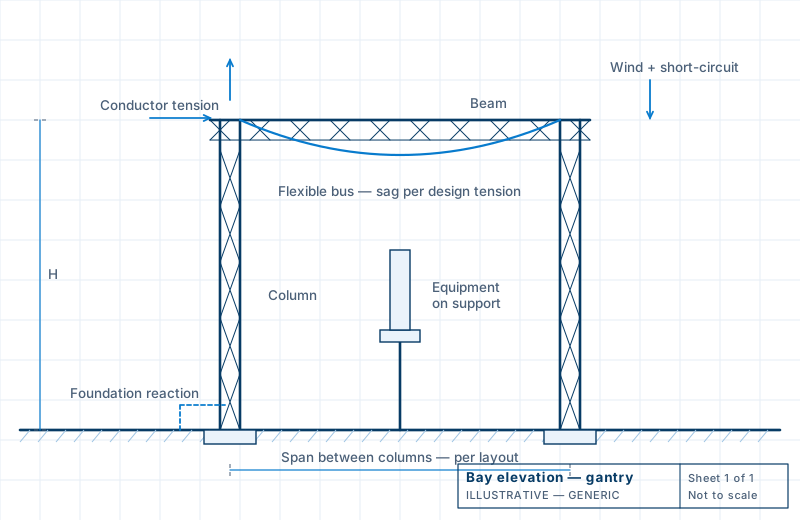
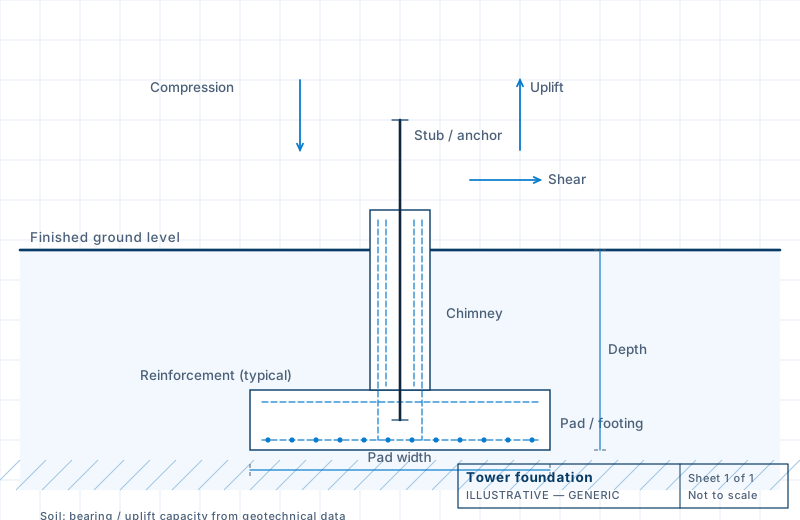
Sheets shown are generic illustrations prepared for this website. They are not drawings from any client project.
| Tool | Typical use |
|---|---|
| SES‑CDEGS | Earthing and grounding analysis |
| ETAP | Power system studies |
| PSCAD | Electromagnetic transient simulation, where a study requires it |
| AutoCAD | Drafting and drawing production |
| STAAD.Pro | Structural analysis and design |
| PLS-CADD | Overhead line design, sag-tension and spotting |
| DIALux evo | Lighting calculations |
Product names belong to their owners. Listing them describes our working tools; it is not an endorsement or a partnership.
The approved project requirement governs; general codes inform the design and fill gaps. This describes working practice and is not a certification.
Tell us the voltage level, the type of station, plant or line, the scope you need and the dates you are working to. We will confirm the inputs we need and a realistic submission sequence.